
1.3 million. That’s the number of European students who went abroad with Erasmus+ in ten years. Behind this figure lies a sometimes opaque mechanism: each university applies its own rules, quotas vary, and applications pile up. One constant remains: for the candidate, the journey often resembles an administrative crossing fraught with obstacles.
The Erasmus+ program leaves nothing to chance. Places are limited by university, criteria are strict, and everything goes through meticulously negotiated bilateral agreements. At each stage, procedures change according to the institution, with no single point of contact to guide each student through the maze of steps. Some countries require official translations, while others demand unique attestations, rarely mentioned in guides or on official websites.
In the face of this jungle, new specialized platforms have emerged. They offer tailored support, step by step, filling the gaps left by institutional circuits. The result: preparation for departure and integration on-site take on a much more concrete turn, far from the administrative headache that discourages many.
Understanding Erasmus+: a springboard to international opportunities for students
Since its inception, Erasmus+ has opened horizons for thousands of students eager to follow part of their curriculum or undertake an internship abroad. This program relies on agreements forged between partner universities and the Erasmus+ Charter (ECHE) that governs exchanges. In practical terms, every candidate must go through the international relations office of their institution, the starting point of a demanding administrative journey, from compiling the application to obtaining the Erasmus+ grant or international mobility aid (AMI), funds awarded under conditions that require foresight and rigor.
The duration of stays ranges from two months to a full year, with each credit validated abroad being accounted for through the ECTS system. This mechanism opens the door to world-renowned universities, promoting double degrees and enriching each participant’s CV. However, behind these opportunities, the administrative follow-up remains dense: between charters, agreements, and course validations, coordination between the home university and the host institution leaves no room for improvisation.
In this context, digital platforms become valuable allies. Take the example of ENT in La Rochelle: this portal centralizes all the procedures and information, from application to local integration, for international students. A tool that lightens the mental load while ensuring effective follow-up at every stage of the journey.
The Erasmus+ experience leaves nothing to chance. French universities, supported by the relevant ministry, implement labeled systems such as “Welcome to France” to ensure a structured and welcoming reception. These programs rely on dedicated teams, efficient management tools, and continuously adapt to the evolving European context. Participating in Erasmus+ is not just about exchanging campuses: it’s about building a path, legitimizing skills, and opening doors to the professional world, sometimes even where they were least expected.
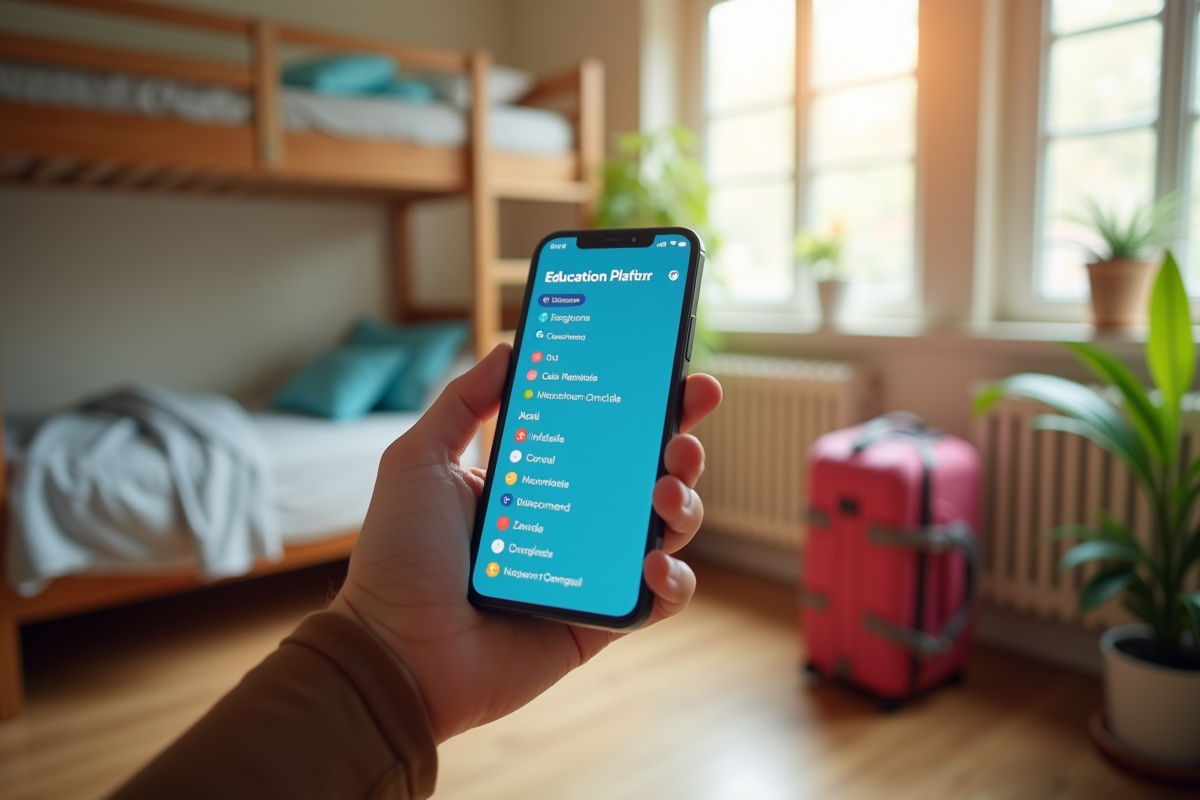
Which platforms facilitate procedures and integration during an Erasmus+ stay?
Preparing for a stay abroad involves juggling multiple, sometimes bewildering procedures. For international students choosing Erasmus+ mobility, successful integration depends on the ability to gather their steps and quickly access useful information. Digital platforms play a key role, simplifying not only administrative paperwork but also access to everything related to daily life: housing, health insurance, schooling, student visa.
Here are the main steps and tools that mark the journey of mobile students:
- Parcoursup: the starting point for choosing a program in France that includes international elements. This portal provides a comprehensive view of courses, partnerships, and redirects to detailed sheets for each program.
- After admission, it’s crucial to quickly initiate the steps to obtain a student visa and subscribe to health insurance. These steps are decisive for settling smoothly in the host country.
- Once on-site, management tools connected to partner universities and international relations offices take over. The Erasmus+ app and the European student card facilitate the recognition of student rights and access to all local services.
- Some universities also offer personalized support, a real boost for discovering the host country, university life, or navigating the local job market.
Through these systems, international mobility becomes more accessible and less daunting. Students gain autonomy while benefiting from a reassuring framework. Technology and humanity come together to transform the Erasmus+ experience into a constructive adventure, far from being just an administrative formality.
Studying abroad is much more than a simple change of scenery: it’s about reinventing one’s path, broadening perspectives, and charting a course, sometimes where no campus map indicated it.