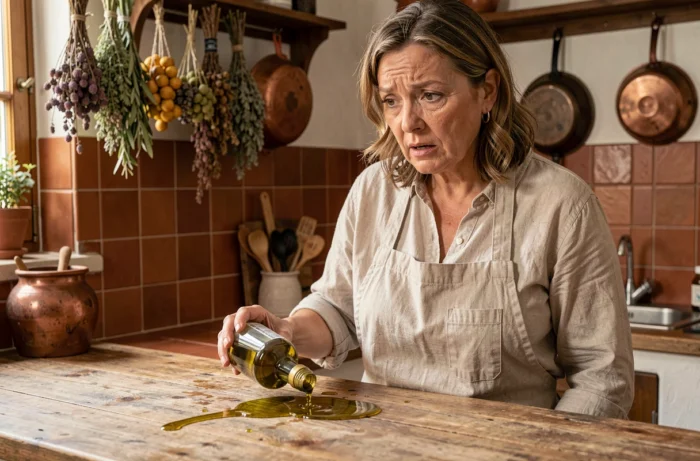
Spilling oil on a table or on the floor still causes today, in several Mediterranean regions, a disproportionate unease compared to mere clumsiness. The superstition associated with this gesture rests on successive layers of meanings—religious, economic, and popular—that have sedimented over several millennia. Understanding their origin allows us to measure the gap between the material fact (a greasy liquid that stains) and the symbolic weight that different cultures attribute to it.
Olive Oil in Antiquity: A Product with Multiple Functions
Competitors often approach the superstition from its religious or dreamlike aspect. The least explored angle remains the concrete versatility of olive oil in ancient societies, which directly illuminates the perceived gravity of its loss.
A synthesis study published in Frontiers in Ecology and Evolution documents ritual, cosmetic, medicinal, culinary, and commercial uses in several ancient Mediterranean societies. Oil was used for lighting, body care, perfumes, and certain artisanal activities. Losing oil meant simultaneously losing a source of light, a remedy, food, and a product for trade.
Each interpretation of spilled oil found in popular traditions reflects one of these functions. Financial fear relates to market value. Spiritual fear relates to sacred use. Domestic fear relates to the difficulty of cleaning a greasy stain on stone or packed earth, in homes where every resource counted.

Spilled Oil Superstition: Comparison Between Regional Traditions
The belief does not have the same intensity or content across countries. The table below gathers documented elements from available sources.
| Region | Assigned Omen | Reported Conjuration Gesture |
|---|---|---|
| Italy (entire country) | Bad luck, possible argument | Throwing salt over the left shoulder |
| South of France | Weakened form of the Italian fear | No specific documented ritual |
| Greece (certain families) | Forewarning of financial loss | No specific documented ritual |
| Spain | Subtle fear, less codified | No specific documented ritual |
Italy stands out clearly: spilled oil and salt bring bad luck, while spilled wine brings good luck. This opposition, well-known among Italians, has no documented origin in ancient texts. It stems from oral tradition and likely reflects the relative economic value of each product at the time the belief was established.
In Greece, the financial dimension dominates: the omen announces material losses. In the south of France and Spain, the superstition exists but remains diffuse, without a codified conjuration ritual.
Religious Symbolism of Oil: Judaism, Christianity, and Anointing Rites
Olive oil holds a place in the foundational texts of the three monotheisms, which explains part of its symbolic weight.
- In Judaism, oil is used for the anointing of kings and for maintaining the menorah. The Torah mentions pure olive oil as an element of worship in the Temple.
- In Christianity, oil is involved in sacraments (baptism, confirmation, anointing of the sick). It symbolizes divine grace and healing.
- In Islam, the olive tree is mentioned in the Quran as a blessed tree, and olive oil is associated with divine light.
Spilling a sacred liquid was akin to profaning a connection with the divine, not just wasting an expensive product. This religious dimension has reinforced popular superstition by giving it a gravity that exceeds mere domestic inconvenience.
Anointing and Political Power
Anointing with olive oil legitimized the power of kings in the Old Testament. The word “messiah” (mashia’h in Hebrew) literally means “anointed.” The act of pouring oil on a sovereign’s head marked their election by God. Accidentally spilling this oil could be perceived as a sign of divine disapproval, a reading that likely nourished domestic superstition through cultural capillarity.
Voluntarily Spilled Oil: Divination and Protection Against the Evil Eye
The superstition is not only about the involuntary act. Mediterranean popular traditions use oil as a tool for divination, completely reversing the relationship with the spilled liquid.
Drops of oil poured into water would allow for the detection of the evil eye according to practices reported in Southern Italy and Greece. The shape taken by the oil on the surface of the water is interpreted: if the drops remain compact, there is no evil eye; if they disperse, a protection ritual is deemed necessary.
This practice shows that oil functions in popular imagination as a revealer of invisible forces. The same liquid can be a sign of misfortune when it falls accidentally, and an instrument of protection when handled with intention. The difference lies entirely in the control of the gesture.
Spilled Oil Superstition and Psychology: Why This Belief Persists
Superstitious beliefs surrounding oil persist in societies where food scarcity is no longer a daily issue. Several factors explain this longevity.
Family transmission plays a central role. A child who sees their grandmother react with horror to a spilled bottle of oil registers the emotion before understanding the belief. The superstitious reflex is transmitted through affect, not through argumentation.
The confirmation bias reinforces the mechanism: after spilling oil, a superstitious person will be attentive to negative events in the following days and will attribute them to the initial gesture. Positive events will be ignored or attributed to other causes.
The sensory dimension also matters. Oil stains permanently, its smell lingers, and it makes the floor slippery. The concrete inconvenience of cleaning anchors the belief in an unpleasant physical experience, making it more memorable than an abstract superstition.
The persistence of this belief illustrates how an ancient economic fact (the scarcity of an expensive product), a religious fact (the sacred nature of anointing oil), and a domestic fact (the difficulty of cleaning a greasy stain) combine to produce a cultural reflex that survives the disappearance of its original causes. Olive oil today costs a few euros per liter, but the unease remains intact in Mediterranean kitchens.