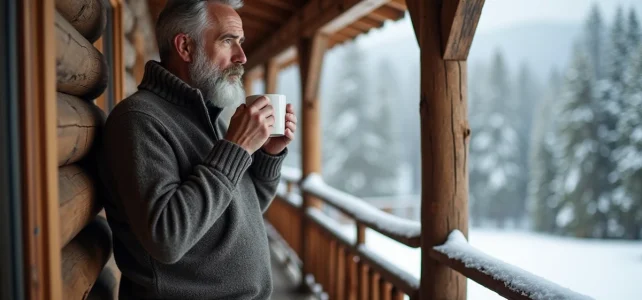
The tax administration does not bother with nuances: a wooden shelter, even insulated, even connected to water, does not become a primary residence simply by the will of its occupants. Without strict adherence to the local urban planning plan, the dream stops there. Yet, every year, some building permit applications find their way into less fussy municipalities, where national regulations, increasingly precise, sometimes seem to fade in the face of ground reality.
Between recent court decisions and geographical disparities, the picture is full of contrasts. Rural areas and suburban zones do not operate on the same register. On one side, technical and financial requirements; on the other, the quest for comfort and freedom. The options abound, but legal security remains a gray area.
Living year-round in a habitable chalet: myth or real opportunity in 2026?
The project of living year-round in a habitable chalet attracts more and more people each year. In France, many dream of a warm habitat, close to nature, designed to last and blend into the landscape. However, transforming a wooden chalet into a primary residence involves crossing many regulatory steps. It all starts with the local urban planning plan: it dictates the location, the authorized surface area, and even the exterior appearance of the construction. It is impossible to ignore the prior declaration of works or the building permit application, once the construction of the chalet exceeds 20 m².
Since the implementation of RE2020 and the announcement of RT2025, energy performance has become a central concern. Insulation, ventilation, heating: every detail counts and often adds to the bill. The initial cost is supplemented by the development tax, the property tax, and even the housing tax. In certain sectors, land is becoming scarce, and the search for a plot is almost an obstacle course.
In the face of these constraints, some also see opportunities. Here are the main advantages regularly highlighted:
- Nature at your doorstep, immediate and accessible,
- Better-controlled budgets than in traditional construction,
- An appreciated adaptability for family or professional changes.
Administrative procedures remain dense, but specialists assist those who wish to take the plunge. For those who want to delve deeper into the subject, learn more on Design en Ville: this comprehensive file analyzes the possible choices and the realities of the sector.
Plans and options for garden sheds: a panorama of solutions for sustainable installation
Gardens are no longer just playgrounds: the market for garden sheds is evolving rapidly. Individuals and designers today juggle between kit chalets, custom chalets, or even small wooden houses. Each solution opens a different path toward sustainable and functional living. A garden studio, for example, fits perfectly as an independent living space, or even as a kitchen nook for families seeking modularity.
The pool house, long relegated to a dependency, sometimes becomes a true micro-house, designed for daily comfort. The plans offered by a specialized builder are always adapted to the requirements of the local urban planning plan. The town hall imposes a prior declaration of works and frames each project: surface area, ground coverage, technical connections. Above all, the viability of the buildable land conditions the success of the project, as each plot has its own rules and potentials.
Some options stand out particularly for structuring one’s project:
- The custom chalet, perfect for blending into the landscape and modulating the space according to one’s desires,
- The timber frame house, ideal for quick assembly and high thermal performance,
- The revamped garden shed, which becomes, in turn, a workshop, office, or living annex.
Forget the rustic cabin: these constructions are part of a broader reflection on the habitat of tomorrow, balancing architectural freedom and regulatory framework. Candidates for installation must juggle a mosaic of standards, but also seize this promise: that of an autonomous, sustainable space truly designed for their lifestyle.
What practical advice for arranging and customizing your chalet year-round?
To succeed in setting up a habitable chalet, everything starts with thermal insulation. The RE2020 standards have changed the game: walls, roofs, and floors require effective insulation. Wood wool, cellulose wadding, and bio-sourced panels are now found in most serious projects. On the heating side, the heat pump combines efficiency and economy, while the wood stove retains faithful followers for its comfort and ease of maintenance.
Interior layout must be designed for all seasons. A sliding glass door maximizes light and creates a direct link with the outside, blurring the boundary between indoors and outdoors. The covered terrace extends the house and allows enjoyment of every moment, even when the sky looks gloomy.
Recommended arrangements
Some layout choices facilitate daily life:
- Favor a bedroom with an adjoining shower room for more comfort,
- Optimize every square meter: integrated storage, modular work space, well-oriented reading nook,
- Select materials that resist humidity and require minimal maintenance.
The roof should receive full attention: well-designed, it provides lasting protection against moisture and climatic whims. The furniture, for its part, should cleverly combine versatility and comfort. Modular, foldable solutions are preferred, designed to adjust to a reduced space. With each season, the layout should be adapted, with flexibility and simplicity in mind.
Living in a chalet is no longer a postcard fantasy or the privilege of a few outsiders: it is a concrete, demanding, and sometimes unpredictable adventure. The question remains who, tomorrow, will dare to cross the threshold and write their own story, between wood and light.