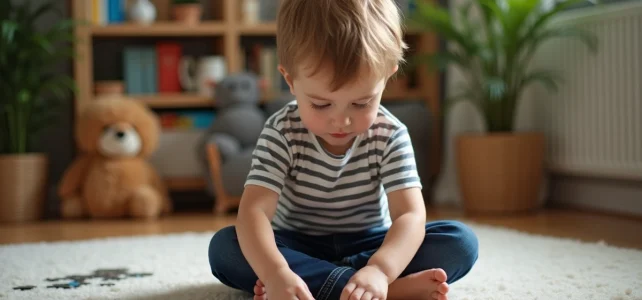
Some children assemble 100-piece puzzles before the age of five, seemingly without any method and without external help. This atypical behavior often escapes the usual criteria for high potential, which focus on academic precocity or language skills. Adult reactions range from admiration to concern, due to a lack of clear benchmarks to interpret these abilities.
Solutions exist to support these children in their development. Specialists recommend adapting activities and diversifying materials to nurture their curiosity without overstimulating them. Careful monitoring helps avoid boredom and frustration, two often overlooked risks in this context.
When puzzles reveal high potential in a child: signs and characteristics to observe
Identifying a child with high intellectual potential is not a straightforward recipe. However, in the case of the gifted child, a surprising ease with puzzles consistently emerges. Some tackle assembly games well beyond their age group, driven by a unique logic that is subtle yet fiercely effective. For them, the puzzle is no longer just a pastime: it becomes a revelation of a holistic vision, remarkable memory, and the ability to create innovative strategies piece by piece.
Specialists often notice several characteristic traits: a highly developed visual memory, a creativity that exceeds the norm, sometimes coupled with hypersensitivity or hyperesthesia. This profile, sometimes referred to as zebra, frequently shows a slight disconnect in social interactions. The puzzle enthusiast goes straight to the point, observes, waits where others become impatient, and turns difficulties into stimulating challenges rather than obstacles.
In observing these abilities, the temptation is great to worry or marvel. Does your child show an unrelenting curiosity, an ability to feel intensely, a desire to push each exploration further? Most often, this high intellectual potential is accompanied by great sensitivity and a need to be understood in their complexity. To delve deeper and have reliable tools to support this journey, learn more at Family 2 Family.
How to recognize a child gifted in puzzles? Questions to consider as a parent
Witnessing your child instinctively solve complex puzzles is striking. This extraordinary ability is not due to chance. A gifted child in this area stands out by their way of visualizing the whole, anticipating each step, and mentally organizing the pieces long before touching the first one. Even in preschool, some already display a fascination for assembly games, coupled with a patience and curiosity that surprise those around them.
To help clarify, examine the following behaviors:
- Does your child spontaneously choose puzzles whose difficulty far exceeds what is expected for their age?
- Can they solve complex puzzles without help or a model, inventing their own method?
- Do they show an unwavering perseverance where other children become discouraged?
- Does their visual memory allow them to recall tiny details forgotten by others?
- Do they feel the need to understand the “why” of each piece, to the point of creating their own rules for the game?
Only a IQ test conducted by a professional can formally validate giftedness, with a threshold of 130 indicating the presence of high potential. But beyond the number, the richness of these children is reflected in the diversity of their approaches to logic, spatial perception, and keen observation. Recognizing a little genius is primarily about detecting the intensity with which they engage with challenges.
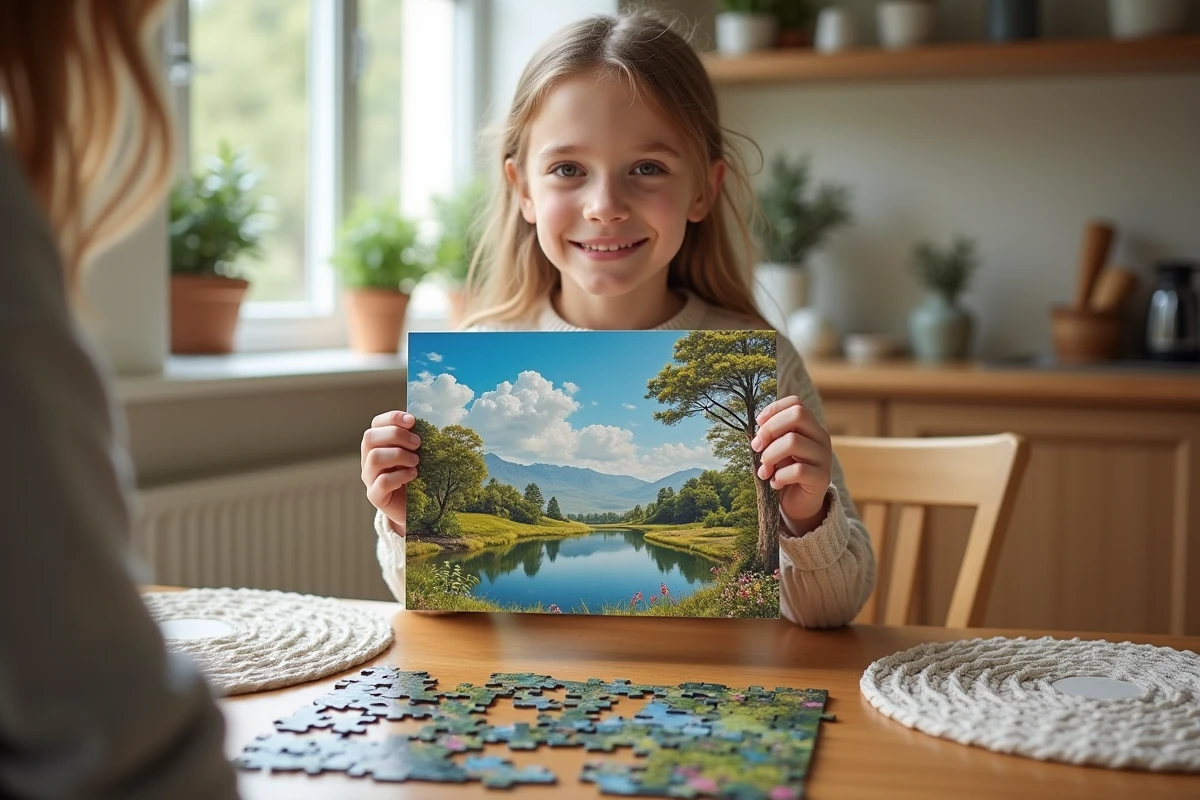
Concrete ways to support and stimulate their talent daily
When puzzles become the favorite playground of a child with high potential, it is essential to provide them with a sufficiently stimulating environment while maintaining a measured attention to their reactions. From the family’s side, it is helpful to broaden the range of offerings: a variety of puzzles, diverse mechanisms, and exploration of new challenges. Progress is never linear: alternating between classic puzzles, mazes, construction games, or visual riddles helps maintain motivation, introduce new elements, and limit the risk of boredom, which is common in gifted children.
Approaches like Montessori pedagogy or other active methods can foster autonomy and sustain the joy of discovery through experimentation. It is better to encourage the child to invent, manipulate, and test new rules rather than impose a single path to resolution. Stay attentive to their signals: some very gifted children may be sensitive to repetition, swinging between enthusiasm and sudden fatigue. In these situations, adjust the difficulty, stimulate exchanges with peers, organize collaborative workshops, or connect with associations like AFEP or ANPEIP to find new points of contact.
Schools also have a role to play. Engage in dialogue with teachers, share your observations, explore adjustments to their learning path, or the possibility of project-based work, even considering grade skipping based on the child’s actual needs. Finally, remember that even a child very comfortable with puzzles may encounter emotional difficulties or identity questions: targeted psychological support, whether temporary or more regular, can help them develop self-confidence and build bridges with others, away from isolation.
Opening up possibilities, respecting the unique rhythm of each young puzzle enthusiast, is to offer a child the taste for challenge without ever taking away their uniqueness. Perhaps, at the end of a completed puzzle, that spark of pride and smile will emerge, conveying everything without a word.