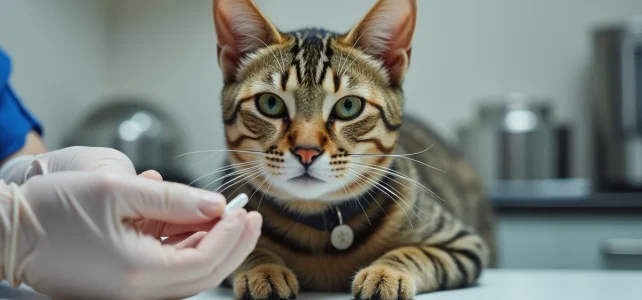
The contraceptive pill for cats relies on synthetic progestins (megestrol acetate, medroxyprogesterone acetate) that block ovulation by maintaining an artificially high hormonal level. Since 2023-2024, the French regulatory framework requires a veterinary prescription for the dispensing of these molecules, rendering the notion of “pill without prescription” obsolete in physical pharmacies.
Oral progestins in female cats: pharmacology and cumulative toxicity
Megestrol acetate acts as a progesterone agonist. Administered during the anestrus phase, it prolongs ovarian quiescence. The issue lies in the dose-dependent and time-dependent toxicity of this class of molecules on the hormone-sensitive tissues of the cat.
The documented side effects are not merely warnings. In practice, we observe a clear correlation between the duration of exposure to progestins and the occurrence of serious pathologies. French, Belgian, and Swiss veterinary associations have indeed tightened their recommendations in 2024-2025, emphasizing the observed increase in cases of pyometra and mammary tumors in female cats exposed for several years.
- Pyometra (purulent uterine infection) constitutes a surgical emergency, with prognosis deteriorating rapidly without intervention, and progestins significantly increase its incidence.
- Mammary tumors, mostly malignant in female cats, see their risk increase with each additional cycle under oral hormonal treatment.
- Iatrogenic diabetes, caused by the anti-insulin effect of progestins, can become irreversible after prolonged exposure.
- Cystic uterine hyperplasia, often silent, frequently precedes pyometra and goes unnoticed without follow-up ultrasound.
Searching for the contraceptive pill for cats without a prescription online remains a common reflex, but serious European platforms are gradually removing these products from their catalogs. Since early 2025, several veterinary marketplaces based in Germany and the Netherlands have voluntarily removed these references in response to alerts from ANSES and EMA.

Deslorelin implant: off-label use in female cats in 2026
Deslorelin (Suprelorin) is a GnRH agonist initially approved for dogs and ferrets. Its mechanism differs radically from progestins: after an initial stimulation phase, it causes a desensitization of the hypothalamic-pituitary axis that suppresses the production of FSH and LH, stopping the ovarian cycle.
Since 2023-2024, feedback presented at European veterinary congresses documents better medium-term tolerance than continuous oral progestins. However, we recommend considering several limitations specific to this off-label use.
The duration of action varies among individuals, from several months to over a year, with no possibility of precisely predicting the resumption of the cycle. The initial stimulation phase (the first weeks post-implantation) can trigger heat and ovulation, necessitating the isolation of the female cat from intact males during this window.
No specific marketing authorization for female cats exists to date, meaning that the veterinarian prescribes under their responsibility, with informed consent from the owner. The cost of the implant, higher than that of the pill on an annual basis, is justified by the absence of the metabolic effects of progestins.
Delayed progestin injections: false security compared to the pill
Medroxyprogesterone acetate injections offer apparent convenience by eliminating the need for daily administration. However, their active ingredient belongs to the same family as oral pills, and the risk profile remains comparable.
The pharmacokinetic difference even exacerbates certain scenarios. An injection deposits a delayed dose that cannot be removed. If an adverse effect occurs (diabetogenic reaction, onset of pyometra), hormonal exposure cannot be interrupted as one would simply stop a tablet. This point is often underestimated.
We use injections in a very limited context: temporary postponement of sterilization for medical reasons (anesthesia contraindicated in the short term), or emergency behavioral management in feline groups, never as routine contraception.

Surgical sterilization: benefit-risk ratio compared to hormonal alternatives
Ovariectomy (or ovariohysterectomy) remains the only method that eliminates the risk of pyometra definitively and significantly reduces the risk of mammary tumors, provided it is performed before the first heat or within the first cycles.
Some owners refuse the irreversibility of the procedure. This reluctance pushes towards hormonal solutions, but the cumulative costs and risks exceed those of sterilization within a few years. Follow-up consultations, uterine control ultrasounds, and treatment of potential complications transform chemical contraception into a recurring budget item.
When sterilization is not immediately possible
For a cat awaiting surgery (animal too young according to the practitioner’s protocol, concurrent pathology), the deslorelin implant currently represents the best-documented compromise. The pill no longer has its place as a prolonged waiting solution.
Feline contraception in 2026 boils down to a choice between a definitive and safe solution (sterilization) and temporary solutions, of which the only truly defensible one from a medical standpoint is the off-label implant, prescribed and monitored by a veterinarian. Oral or injectable progestins, whether purchased online or dispensed by prescription, expose the cat to pathologies whose treatment costs far more than prevention.