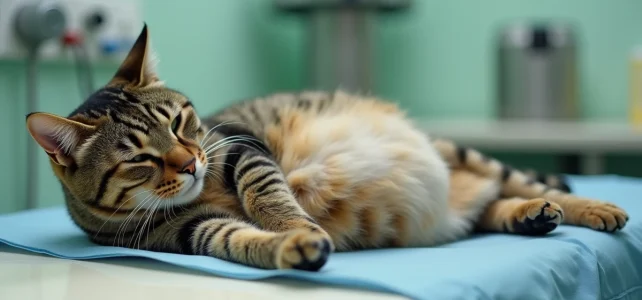
An adult cat whose abdomen increases in size over a few days or weeks presents a clinical sign that encompasses very different realities. Behind a bloated belly in a cat, one can find both a simple temporary bloating and an abdominal effusion related to a cardiac or tumor-related pathology. The difficulty for the owner lies in this range: the same visible symptom can correspond to a vital emergency or to an excess of kibble swallowed too quickly.
Abdominal effusion or digestive bloating: a distinction that palpation alone cannot resolve
Most articles on the subject list causes (parasites, constipation, peritonitis) without emphasizing a fundamental triage point: a bloated belly is not always a belly full of gas. Ascites, which is the accumulation of free fluid in the abdominal cavity, gives a visually similar appearance to pronounced digestive bloating.
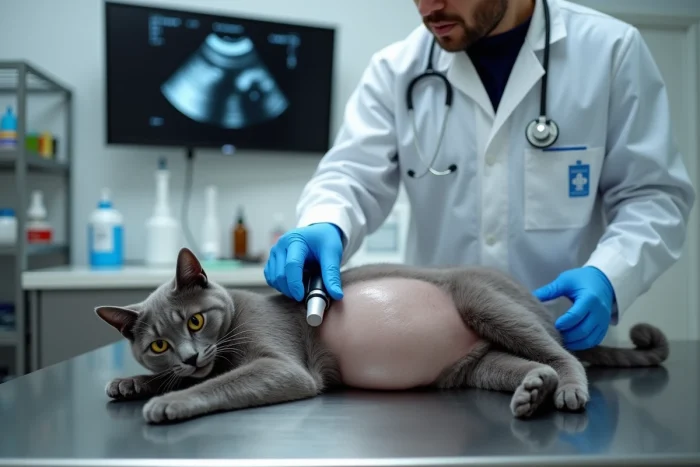
The difference is determined by palpation and especially by ultrasound. An abdomen filled with fluid tends to change shape when the cat moves: the belly “drops” due to gravity. An abdomen distended by gas or fecal matter remains firmer and more symmetrical. However, an owner without veterinary training cannot reliably make this diagnosis.
Ascites in an adult cat points to serious possibilities: right heart failure, advanced liver disease, abdominal tumor, or feline infectious peritonitis (FIP). To better understand the causes of a bloated belly in adult cats, the distinction between liquid and gas remains the first filter to apply before any hypothesis.
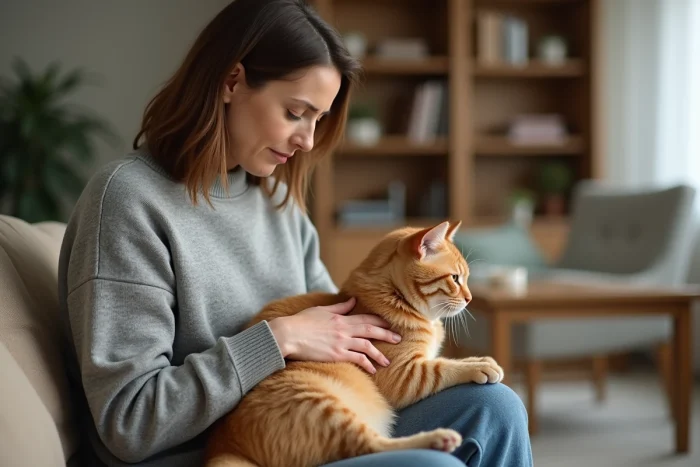
Digestive parasites in adult cats: an underestimated risk after the kitten stage
Intestinal parasites do not disappear with age. Adult cats that go outside, hunt, or live communally remain exposed to roundworms, hookworms, and Giardia, as highlighted by ESCCAP recommendations.
In adults, parasitic infestation often produces more subtle symptoms than in kittens. The belly may simply appear “round” without significant distension, with intermittent soft stools or fluctuating appetite. These signs can easily go unnoticed, especially in an outdoor cat whose litter box is not monitored.
A regular anti-parasitic protocol, tailored to the cat’s lifestyle, remains the most direct preventive measure. Strictly indoor cats present a lower risk, but not zero: larvae can be introduced by shoes or other household animals.
Feline infectious peritonitis: the prognosis has changed
FIP has historically been presented as a fatal disease. This statement deserves to be nuanced in light of recent advances. Since 2024, protocols using specific antivirals are now used by veterinarians in France, significantly altering the prognosis of certain forms of the disease.
FIP frequently causes a “wet” form with fluid accumulation in the abdomen, leading to rapid and marked abdominal swelling. The “dry” form manifests more through granulomas in the organs, with less visible symptoms in the belly. In both cases, the diagnosis relies on a combination of clinical, biological, and sometimes histological arguments.
The existence of antiviral treatments does not mean that FIP has become benign. Management remains heavy, costly, and requires close veterinary follow-up. Clinical regressions remain limited, and long-term monitoring of these protocols is still under evaluation.
Alert signs associated with FIP
- Persistent fever that does not respond to conventional anti-inflammatories, accompanied by progressive weight loss
- Rapid abdominal swelling with a “fluctuating” abdomen upon touch, suggesting the presence of fluid
- Marked lethargy, total loss of appetite, and sometimes jaundice (yellowing of the mucous membranes)
Chronic constipation and diet: when a cat’s bloated belly indicates a transit problem
Constipation is among the most common and least serious causes of a distended abdomen. A cat that does not produce stools for two days or more accumulates matter in the colon, which ultimately leads to a firm and voluminous belly.
Insufficient hydration is the most common triggering factor for feline constipation. Cats fed exclusively on kibble and that drink little are particularly at risk. Introducing a wet diet (canned food, fresh pouches) or installing a water fountain may be enough to resolve the issue in simple cases.
Some cats develop megacolon, a chronic dilation of the colon that reduces its ability to propel stools. This condition requires regular veterinary follow-up and sometimes long-term treatment. The boundary between simple constipation and early megacolon is not always clear without further examination.
Signals that warrant a quick consultation
- Absence of stools for more than 48 hours, associated with unsuccessful attempts in the litter box
- Repeated vomiting combined with abdominal swelling, a possible sign of intestinal obstruction
- Difficulty breathing or rapid breathing, which may indicate that abdominal distension is compressing the diaphragm
- Total loss of appetite for more than 24 hours in a normally greedy cat
An adult cat that refuses to eat for more than two days is at risk of hepatic lipidosis, a potentially serious fatty degeneration of the liver. Prolonged fasting in cats is never trivial, even if the abdominal swelling seems moderate.
In the face of persistent abdominal bloating, the only reliable approach remains a veterinary examination with palpation, blood tests, and ultrasound if necessary. Benign and serious causes can sometimes produce exactly the same external presentation, and waiting for “it to pass” amounts to betting on a diagnosis without having the elements to make it.