
A plastic cutting board marked with deep grooves is not recycled as easily as food packaging. The type of polymer, surface condition, and local sorting facilities determine whether the item will be recycled, buried, or incinerated. Here, we detail the technical parameters that condition each end-of-life option.
Resin code and sorting system: what hinders the recycling of a plastic cutting board
Most cutting boards are made from polypropylene (PP, code 5) or high-density polyethylene (HDPE, code 2). Both of these resins are technically recyclable. The problem lies downstream: sorting centers calibrate their lines for household packaging, not for large rigid objects.
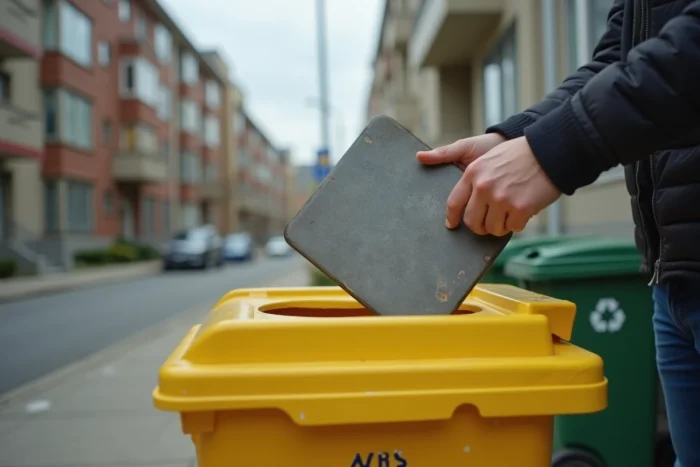
A selective collection bin accepts bottles, jars, and trays. A thick board several millimeters thick, often without visible markings, is rejected by optical or manual sorters. It then joins the “refusal to sort” fraction and is sent for incineration or burial.
We recommend checking the triangular pictogram on the back of the board. If it indicates a code 5 or 2, the recycling center remains the most reliable route: some accept rigid plastics outside of packaging in a dedicated bin. Without markings, consider the item as non-recyclable in the standard circuit.
To find out precisely where to dispose of a plastic cutting board with Matin Gourmand, you need to cross-reference the type of resin with your community’s guidelines, as they vary significantly from one municipality to another.
“Recyclable” plastic boards: why the promise remains a problem
The “recyclable” marking on a product made of PP or HDPE indicates a property of the material, not a guarantee of acceptance. Less than half of rigid plastics outside of packaging find an effective recycling route in France. The cutting board perfectly illustrates this gap between theoretical recyclability and actual recycling.
Several factors worsen the situation for used kitchen utensils:
- The grooves and cuts accumulated over the years trap organic residues and fats, contaminating the recycling stream and degrading the quality of the regenerated plastic.
- The dyes, antimicrobial additives, or mineral fillers incorporated into some boards disrupt the re-melting process and can render the recycled material unusable for food applications.
- The frequent absence of resin markings prevents automatic identification during industrial sorting, defaulting the item to refusal.
Claiming that a plastic board is recycled “like a bottle” is an oversimplification. The technical reality requires treating these objects as residual waste in the majority of French territories.
Grooves, bacteria, and replacement threshold: when to dispose of a cutting board
A board whose grooves do not disappear after thorough cleaning should be removed from service. Deep grooves create niches where bacteria survive washing, even with hot water and dish soap.
The nail test works well: run your nail perpendicular to the knife marks. If you feel distinct and closely spaced depressions across the surface, replacement is necessary. The health question takes precedence over the environmental question.
End-of-life cleaning before disposal
Before placing the board in the recycling center or household waste bin, a quick cleaning minimizes odors and facilitates potential recycling. Scrub the surface with soapy hot water, rinse, and let it dry. No need for thorough disinfection: the goal is to eliminate food residues, not to make the item reusable.
Alternatives to plastic: wood, glass, or composite for the kitchen
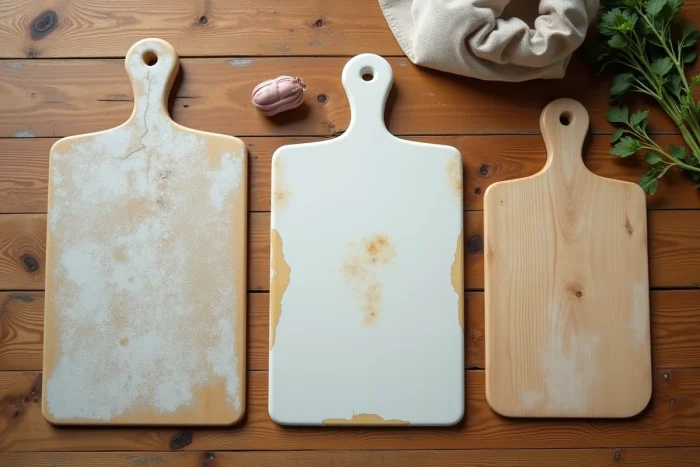
Replacing a plastic board with solid wood (beech, maple, bamboo) reduces the problem of food microplastics documented in recent scientific literature. Wood has a surface that partially closes after cutting, limiting bacterial colonization provided it is regularly maintained with food-grade mineral oil.
Tempered glass is available as a cutting surface, but it quickly dulls knife blades. Wood-resin composites offer a compromise in durability, although their end-of-life poses the same sorting questions as pure plastic.
Maintaining a wooden board to extend its lifespan
- Apply a thin layer of food-grade oil (mineral oil or dedicated blend) every month on a board used daily.
- Clean with warm water and soap immediately after each use, without prolonged soaking.
- Lightly sand the surface with fine sandpaper (180-220 grit) as soon as grooves appear, then oil again.
A well-maintained wooden board lasts several years before needing replacement, compared to a significantly shorter cycle for plastic subjected to intensive use.
Reuse of a used plastic cutting board: realistic options
Before disposal, a board whose surface is too damaged for cooking can serve as a DIY support, a work surface protector during gluing or painting, or a rigid wedge. Non-food reuse remains the best environmental option when recycling is not accessible.
Large boards can be easily cut with a jigsaw to become drawer dividers, bottom tray protectors, or seedling supports in gardening. These secondary uses extend the lifespan of the material without requiring industrial transformation.
Donating through online community groups also works, provided it is clearly stated that the board is no longer suitable for food use. Any potential buyer must know the condition of the surface before deciding.
The management of a plastic cutting board at the end of its life hinges on three parameters: the resin code, the surface condition, and the sorting capabilities of the territory. When no local facility accepts the item, non-food reuse remains the only option that avoids burial.